Photos : Wangdue Festival 09/10 Divine Mad Man Area 09/10 Gangtey Gompa Festival 09/10
Another day another chance at a festival
 A short drive from our hotel is the Wangdue Phodrang Dzong. Founded by Zhabdrung Ngawang Namgyal in 1638 it serves as the place for the Tshechu Festival. Like many of the zhongs in Bhutan, the location is against a dramatic backdrop however nowhere close to the Tigers Nest. Here you can drive to the zhong however it is perched on a high ridge overlooking a river junction.
Departure time was 0430 so we could make the zhong in time to see the unfurling of the flag. By the time we arrived at the zhong it was just after sunrise but before the zhong was bathed in sunlight. This meant the flag was proudly on display by the time we arrived. Whilst the festival happens each year it’s only on special occasions where you are able to witness the unfurling of the flag (or at least that’s what we were told). It’s the flag past which people queue in order to be blessed by the monks who have their ‘monk table’ at the base of the flag. The flag is about 55 feet high (my estimate but I could be completely wrong) in height and provides a great backdrop to the festivities.
Wanting to respect the Bhutanese religious beliefs and the people we wanted to observe whilst being able record the event in the lest unobtrusive fashion, we positioned ourselves to the side of the square. We were also naive in thinking the other tourists would conform to our way of thinking. Basically it comes down to respect and common sense. It’s sad to report the Germans and the US failed to contemplate they were witnessing a personal and spiritual event. Such an even doesn’t require them to push through the local crowd, doesn’t require them to stand in front of the local people trying to enjoy the festival, doesn’t require them to stand in the way of the local people trying to see the dancing/ceremony and last (but not least) always getting in the way of our damn photos!!!!! Muppets!!!
Unlike the Timkat festival in Ethiopia where the people are the festival, here the festival is about the ‘religious’ aspect. The dances are mostly,or at least as far as my small non Buddhist and non Bhutanese brain can understand, about the forthcoming year in relation to their health and prosperity (not necessarily financial).
When one dance isn’t enough
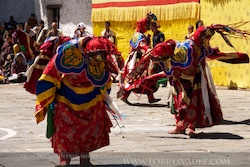 You’ve seen 2 dances you’ve seen them all…..okay that may sound a little harsh but after being at the zhong pre dawn to 1300, one dance to the next where the only discernible difference is the colour of the masks worn, the dancing can become somewhat tiresome. Now keep in the mind this is from me who isn’t Buddhist and can’t dance to save his life and maybe can’t appreciate the intricate moves. That aside the photographer, albeit amateur at best, in me was relishing each opportunity attempting to capture the moment through the lens.
People, except for the foreigners, were in their national dress of varying colours and bright adornments, in the form of sashes draped over their shoulders. Those carrying children do so with a cloth wrap that squashes the child to the back and is tied at the front across the chest. These wraps are also brightly coloured adding to the kaleidoscope of human canvases.
When the festival starts in earnest, there’s a kaleidoscope of colours and movement. It’s a photographers delight as evidenced by the plethora of foreigners vying for the vantage points to capture the procession/proceedings. It was a shame to have so many foreigners standing in the middle of the courtyard or in positions that both impeded the queue to the flag and seemed rude or disrespectful to the Bhutanese. It was almost impossible to take a photo without a camera lens or foreign dressed person detracting from the shot. Not wanting to generalise but it was the US, the French and Japanese that were rude by pushing in front of the Bhutanese and seemingly oblivious their actions could be considered anything but acceptable. With large lenses they still pushed themselves and their cameras confrontationally in the faces of the monks, the children, the parents and anything that wasn’t in western dress.
Where’s the Divine Mad Man and foreign devil smack down phallus when you need it?
Soon our attention moved to the center where his royal monkness was seated replete/complete with orange and yellow robe with obligatory bald head. In front of Mr Morange (MOnk oRANGE) his young red robed and bald headed brethren were seated in 2 rows on each side. Not sure what was to ensue we continued to snap away photo after photo. I soon realised that some of the reasons for the young monks to be seated was to :
- a) get some food
- b) collect their pocket money and
- c) make some noise (some would say music)
By the end of it, each of the red monks had a small collection of food that looked neither appertising nor filling. I suspect they starved them for a week before hand so they’d at least be grateful for the offerings.
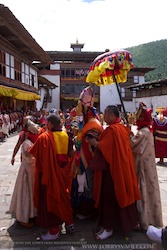 A flag was proudly carried between the rows of monks and presented to Mr Morange who I think either found a dirty spot on it and was trying to clean it or he may have blessed it. Either way this was pretty much the end of the monk dinner show. The music started and the red monks went from increasing their wealth to budding musicians. There were cymbals, horns, large drums and a sea shell. I’m not sure if they were playing tunes from “110 monk songs to pull your teeth by” or some rendition of “the divine madman’s manic love song” but they seemed to be trying to play in tune and importantly the same song. The Monkcert appeared to conclude this part of the proceedings. Mr Morange attempted a majestic self ‘dethroning’ however he looked more like a yellow robed caped crusader swirling his cape around his body. His departure led to the courtyard being cleared of sitting Buddhists paving the way for the dancing and singing.
Throughout the morning the dances changed, only slightly to the untrained eye, in concert with the masks and costumes. Their movements tell stories about history and fantasy.
The locals knew the score when it comes to the length of the festival and the dances as they came prepared with food and water. The crowd thinned out before the dances had finished and I wasn’t sure if they simply became bored or were happy to depart as they had already received their blessings. They were the smart ones as the dances continue, the sun gets hotter, shade harder to come by and tedium can set in. Stubbornly a few of us remained as we weren’t going to miss the photo opportunities plus I was just plain curious about how much the locals could endure. The answer was revealed when many people returned just in time for the piece de resistance. The last dance sees the masked dancers scaring and escorting the demon spirits out of courtyard. The locals are then once more blessed and the show winds down (at least the above is my understanding).
Clowns of fun and money in a town with no name
 Bull had advised it was good karma to pay the clowns that circulate in courtyard. These clowns are supposedly more like the old court jesters although the entertainment is thin and the demand for money not so. Wearing the obligatory clown wear, colourful clothes but replacing the big red nose and weird hair with a wooden mask, they mocked the police, the people and maybe even the Buddhists (apparently they are the only ones allowed to do so).
We obliged Bull’s request to pony up some readies however when they come back repeatedly and literally demand cash and actually grab you to give them money. It becomes not only tiresome but a personal affront. Whilst the locals are also hit for money, it’s the tourists that are more often than not repeatedly mauled. Some of the Italians and Japanese were not willing to part with any money until we politely suggested they should, could and would…else we pointed to the exit.
We were good natured about the repeated approaches by the clowns and kept saying with a smile that we’d paid so I don’t think any offense was taken however there were times, such as when we were leaving the zhong, they cornered Rachel blocking her from leaving, when it went beyond the acceptable boundaries.
Sufficiently dehydrated, more than ample vitamin D exposure and almost photographed out (well at least from photographing people dancing in bright costumes and aggressive clowns) we headed into the town. I probably shouldn’t even call it a town as it’s more of a collection of stores/huts covered, for the most part, in corrugated iron strewn along the roadside selling all manner of things. Apparently this town is to disappear by the end of 2011 as it’s deemed inappropriate to be so close to Wangdue and sprang up without government approval.
Immediately before the town was a local market on the side of the mountain spread over 3 tiers. This market is for the locals to buy and sell food with the occasional archery arrow thrown in. On the bottom tier was the meat market or more accurately 1 stall selling meat. The rest of the market was all about the food.
A festival in waiting – Gangtey Goenpa/Gonpa
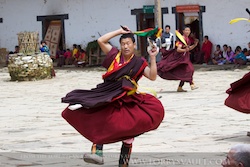 This is a festival in training or at least it was on the day that we were there. Unlike the main festival we had visited that was in full swing and the real deal, Gangtey was rehearsing for the festival (or at least that’s my recollection of what we were told). The outfits worn by the dancers (such as the ones in the pic to the right) and singers are different from the Wangdue festival in they are more ‘rural’. Ok so that may not be a great description but the setting, the people, the atmosphere and the more subdued colours made for a different spectacle.
I suspect the change in festival atmosphere is also to do with the fact the area, or at the least the main village, is home to mainly families of the Gomchens or Lay Monks. I never knew monks could get….ohhhh….Lay Monks. Doh!
The size of the buildings and layout was smaller than Wangdue and pretty much overlooks the Phobjikha Valley, where we would head for lunch and a spot of ‘find the black crane’. The valley is home to the black necked crane that’s an endangered specie that is found in Tibet and Siberia.
 We seemed to have adopted a rain cloud or 50, as no matter where we went it would rain at some point. Today was no exception however we were fortunate that our time spent at Gangtey was filled with sunshine for the most part. Unlike Wangdue where the people were lined up to get blessed and heaving with people, as this was the rehearsal and much smaller, the local people were sitting around the edges of the courtyard enjoying the show and willing you over to take pictures.
At Wangdue most didn’t mind us taking their photos however they rarely asked to have it taken. Here they were thrilled to have their picture taken and often wave you over to take it. The girl in the pic to the right thought it would make the photo worse if she pulled a face however she failed 🙂
It was a delight to be here, appreciated more as we could compare this to the larger and more manic Wangdue The atmosphere was more relaxed, the number of tourist a mere handful, less people, wonderful bright colours and some sunshine materialised as we arrived!
Land Of Fables, Beauty and The Mad Hatter
Throughout the tour you are regaled with stories of demons, deities, scriptures, teachings, lamas and (saving the best for last) the Divine Madman or as I dubbed him, the Mad Hatter. The “Mad Hatter” had or has (I’m not sure if he still exists) some of the most unusual phallus abilities including a phallus that could :
- grow to any length
- shoot fire
- pee gold
- be used as a sword to defend himself
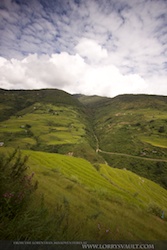
Now before you think I’m being too harsh on the fable telling, on a ‘walk’ to a village covered in a BBC show called Last Man Standing, Bull started to explain how some of this scenery came to look like it does today. Apparently Mr Divine Madman stepped from one side of the valley to the other (the pic below shows the rough distance) and it’s his feet that created the flat areas on either side. Bull also told a story whereby Mr D urinated on a scroll that, upon reaching its destination, had turned the text into gold…not gold colour but actual gold! As reverence to the Madman, phallic symbols adorn many houses in Bhutan. The phalluses are not erotic but a reference to one of Bhutan’s most popular saints, Lama Drukpa Kunley, who lived at the turn of the 15th into the 16th centuries. This guy knew how to party and spent much of his time singing and drinking with younger women and deflowering virgins. On top of all that, he got away with all his antics and was revered….now that’s impressive. 🙂
 The long winded stories recanted by Bull to advise us of these abilities are interesting at first however after the 10th story you do certainly look for the short version (or at least I was looking for it).
The people of Bhutan are wonderful and the most genuine people I’ve had the pleasure to meet. Surrounding mountains are awe inspiring. Driving from town to town is a visual feast ranging from sharp drop offs, old hand made roads complete with stone railings, forests, farmlands, rice fields, valleys…any of them make you appreciate the country more and more.
It’s fair to say that life in Bhutan is simple but it’s not what I would call backward. The Bhutanese democracy/government was created at the behest of the monarchy although, as it was told by Bull, the people and the incumbent government were against the idea. Bull asserted that both sides of government have almost the same ideas and proposed direction/leaning as each other so it’s difficult to get a change in government. If ‘Bhutan According to Bull’ (BAB) is correct, immigration is rare and does not extend to the Tibetans or Indians. Hmmm..interesting notion however I decided that this needed some checking and found this excerpt on Wikipedia ‘Bhutanese immigration policy, as reflected in its citizenship laws, can be described as highly assimilatory, requiring familiarity with the dominant Ngalop culture and allegiance to the Ngalop King of Bhutan. Its broader citizenship policy toward both immigrants and citizens alike can also be described as assimilatory, and on its face, a tool against dissent.’ So BAB and reality aren’t always in synch but who’s to say which version is correct?
Traditionally the houses had a thatched roof however the government banned this in order for conservation reasons. Today the new roofs are corrugated iron however there appears to be a distinct lack of nails so the roof is kept in position by having small slats running along the length of the roof and being held in place by large and/or heavy stones. Roof tops are also used as drying platforms for chili which the Bhutanese adore, especially in the chili cheese (something which I will attest is brilliant but not good for you).
Although much of the country hasn’t been afforded the latest and greatest in education and won’t have access to the internet for everyone, I never got the feeling that was something they missed out on. They seem content and harmonious with themselves and each other. Obviously I wasn’t conducting any research and didn’t ask anyone but the general atmosphere and approach to life I felt could be summed up in one word, contentment. I too was content having made the journey to Bhutan, made even sweeter as I was travelling with good friends.
I could talk more about Bhutan but let’s face it, if you’ve managed to get this far down the page you deserve a medal…all 2 of you! Now go check out the pics as that’s what you’re really interested in. 🙂